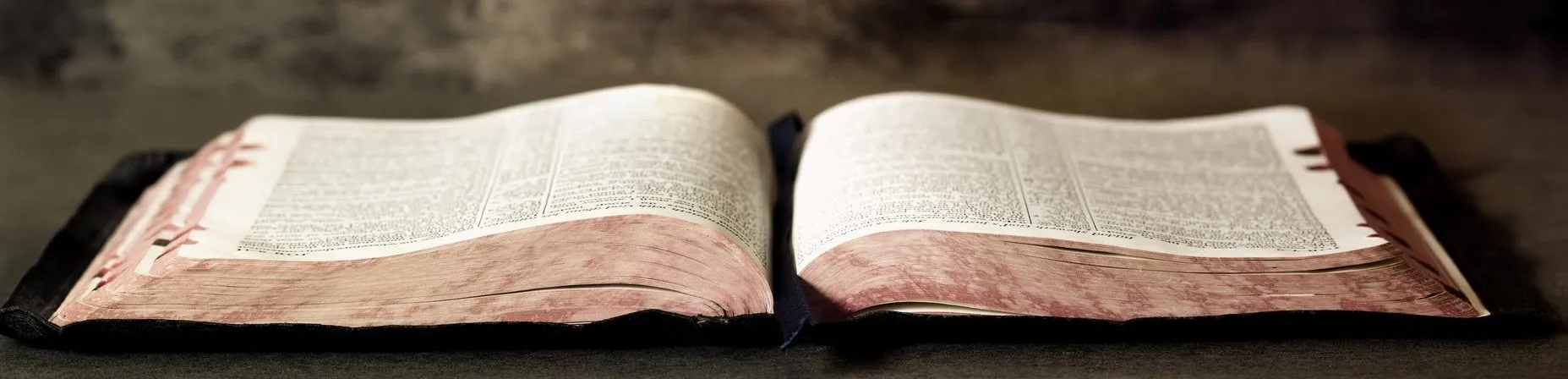
The Old Testament
The Old Testament is a unified library of 39 books that tells one great story: the loss and recovery of paradise. It records God's covenant with Israel, the history of redemption, and the preparation for the coming Messiah. From Creation to the close of the Hebrew canon, every book points forward to Christ.
| Testament | Old Testament |
|---|---|
| Book Count | 39 Books (Genesis – Malachi) |
| Author | Approximately 30 authors — kings, shepherds, prophets, and priests |
| Date Written | c. 1400 B.C. – 400 B.C. (spanning approximately 1,000 years) |
| Language | Hebrew (with small portions in Aramaic) |
| Main Divisions | Law (5), History (12), Poetry (5), Major Prophets (5), Minor Prophets (12) |
| Key Theme | The history of God's interaction with mankind and the preparation for the Messiah |
| Published | March 30, 2026 |
"Wherefore the law was our schoolmaster to bring us unto Christ, that we might be justified by faith."— Galatians 3:24 (KJV)
Meaning of the Name
The term "Testament" translates the Hebrew word berith and the Greek diatheke, both meaning "covenant" or "agreement." The Old Testament records the Old Covenant God made with Israel through Moses at Mount Sinai.
This Covenant defined the relationship between God and His chosen people — outlining His laws, His promises, and the consequences of obedience or rebellion. It was never meant to be the final word, but rather a preparation and a shadow of the New Covenant that would come through Jesus Christ.
Overview
The Old Testament is not a random collection of fables or ancient myths. It is a unified library of 39 books that tells a single story: The Loss and Recovery of Paradise. It begins with the creation of the universe and humanity's fall into sin.
It then narrows its focus to one man (Abraham) and his family (Israel), through whom God promised to bless the world. The rest of the Old Testament details Israel's rollercoaster history — their slavery, liberation, conquest, kingdom, rebellion, exile, and eventual return — setting the stage for the coming Savior.
The Structure: The 5-12-5-5-12 Pattern
The English Bible organizes the Old Testament books not chronologically, but topically — grouped by genre and purpose:
1. The Law (5 Books): Genesis, Exodus, Leviticus, Numbers, Deuteronomy — the foundation and birth of the nation.
2. History (12 Books): Joshua through Esther — the life of the nation in the Promised Land, from conquest to captivity to return.
3. Poetry (5 Books): Job, Psalms, Proverbs, Ecclesiastes, Song of Solomon — the heart and worship of the nation.
4. Major Prophets (5 Books): Isaiah, Jeremiah, Lamentations, Ezekiel, Daniel — extended warnings of judgment and promises of the Messiah.
5. Minor Prophets (12 Books): Hosea through Malachi — specific messages to specific generations (shorter books, not lesser in importance).
Connection to Christ
The Old Testament is "Christ Concealed"; the New Testament is "Christ Revealed." As Jesus Himself declared, the Scriptures testify of Him (John 5:39). Every section of the Old Testament foreshadows the Lord Jesus Christ in a distinct way:
In the Law, He is the Sacrifice — the spotless Lamb who takes away the sin of the world.
In History, He is the Sovereign King — the rightful heir to David's throne and the Captain of God's host.
In Poetry, He is the Shepherd and Wisdom — the Good Shepherd of Psalm 23 and the embodiment of divine wisdom in Proverbs 8.
In Prophecy, He is the Promised Messiah — born of a virgin (Isaiah 7:14), wounded for our transgressions (Isaiah 53:5), born in Bethlehem (Micah 5:2), and entering Jerusalem on a donkey (Zechariah 9:9).
"Search the scriptures; for in them ye think ye have eternal life: and they are they which testify of me." — John 5:39
Part One: The Pentateuch (The Law)
Books: Genesis, Exodus, Leviticus, Numbers, Deuteronomy Key Figure: Moses
This section covers the time from Creation to the death of Moses.
Genesis is the book of beginnings — God creates man, man sins, and God initiates a rescue plan through Abraham.
Exodus records how God redeems His people from slavery in Egypt and gives them His Law at Sinai.
Leviticus teaches that God is holy and can only be approached through blood sacrifice, centered on the Day of Atonement.
Numbers is the "Book of Wanderings" — Israel fails to trust God and wanders in the wilderness for 40 years.
Deuteronomy contains Moses' farewell sermons, restating the Law to the new generation before they enter the Promised Land.
Key Christology: The Seed of the Woman (Genesis 3:15), The Passover Lamb (Exodus 12), The High Priest (Leviticus 16).
"And I will put enmity between thee and the woman, and between thy seed and her seed; it shall bruise thy head, and thou shalt bruise his heel." — Genesis 3:15
Part Two: The Historical Books
Books: Joshua, Judges, Ruth, 1 & 2 Samuel, 1 & 2 Kings, 1 & 2 Chronicles, Ezra, Nehemiah, Esther Key Event: The Rise and Fall of the Kingdom
This section tracks Israel's life in the Land of Canaan through four phases:
Conquest (Joshua): Israel enters and conquers the Promised Land under Joshua's leadership.
Chaos (Judges): "Every man did that which was right in his own eyes" — a repeated cycle of sin, oppression, repentance, and deliverance.
Kingdom (Samuel/Kings/Chronicles): The nation demands a king. Saul fails; David succeeds; Solomon expands the kingdom. It then splits into the North (Israel) and South (Judah), and both eventually fall into idolatry and captivity — Assyria conquers the North; Babylon conquers the South.
Restoration (Ezra/Nehemiah/Esther): After 70 years, a remnant returns to rebuild the Temple and the walls, while God providentially protects those who remained in exile.
Key Christology: The Captain of the Lord's Host (Joshua 5), The Kinsman Redeemer (Ruth), The Son of David (2 Samuel 7).
Part Three: The Poetic Books
Books: Job, Psalms, Proverbs, Ecclesiastes, Song of Solomon Key Theme: The Spiritual Life
These books deal with the heart of man and his relationship with God, addressing the deepest questions of human experience:
Job wrestles with the problem of suffering — why do the righteous suffer?
Psalms is the great book of worship — 150 songs covering prayer, praise, lament, and messianic prophecy.
Proverbs offers divine wisdom for daily life, rooted in "the fear of the LORD."
Ecclesiastes explores the emptiness of life "under the sun" when God is left out of the equation.
Song of Solomon celebrates the beauty of marital love, picturing the relationship between Christ and the Church.
Key Christology: The Suffering Servant (Psalm 22), The Good Shepherd (Psalm 23), The Wisdom of God (Proverbs 8).
"The LORD is my shepherd; I shall not want." — Psalm 23:1
Part Four: The Prophetic Books
Major Prophets: Isaiah, Jeremiah, Lamentations, Ezekiel, Daniel Minor Prophets: Hosea, Joel, Amos, Obadiah, Jonah, Micah, Nahum, Habakkuk, Zephaniah, Haggai, Zechariah, Malachi
The prophets were God's "mouthpieces," sent to warn the nation during the Kingdom years and the Exile. They preached two main messages: Condemnation (repent or face judgment) and Consolation (God will restore Israel and send the Messiah).
Pre-Exilic Prophets warned of the coming Assyrian and Babylonian invasions (Isaiah, Jeremiah, Hosea, Amos).
Exilic Prophets ministered to the captives in Babylon (Ezekiel, Daniel).
Post-Exilic Prophets encouraged the people who returned to rebuild the land (Haggai, Zechariah, Malachi).
Key Christology: Born of a virgin (Isaiah 7:14), Wounded for our transgressions (Isaiah 53:5), Born in Bethlehem (Micah 5:2), Entering Jerusalem on a donkey (Zechariah 9:9), The Sun of Righteousness (Malachi 4:2).
"But he was wounded for our transgressions, he was bruised for our iniquities: the chastisement of our peace was upon him; and with his stripes we are healed." — Isaiah 53:5